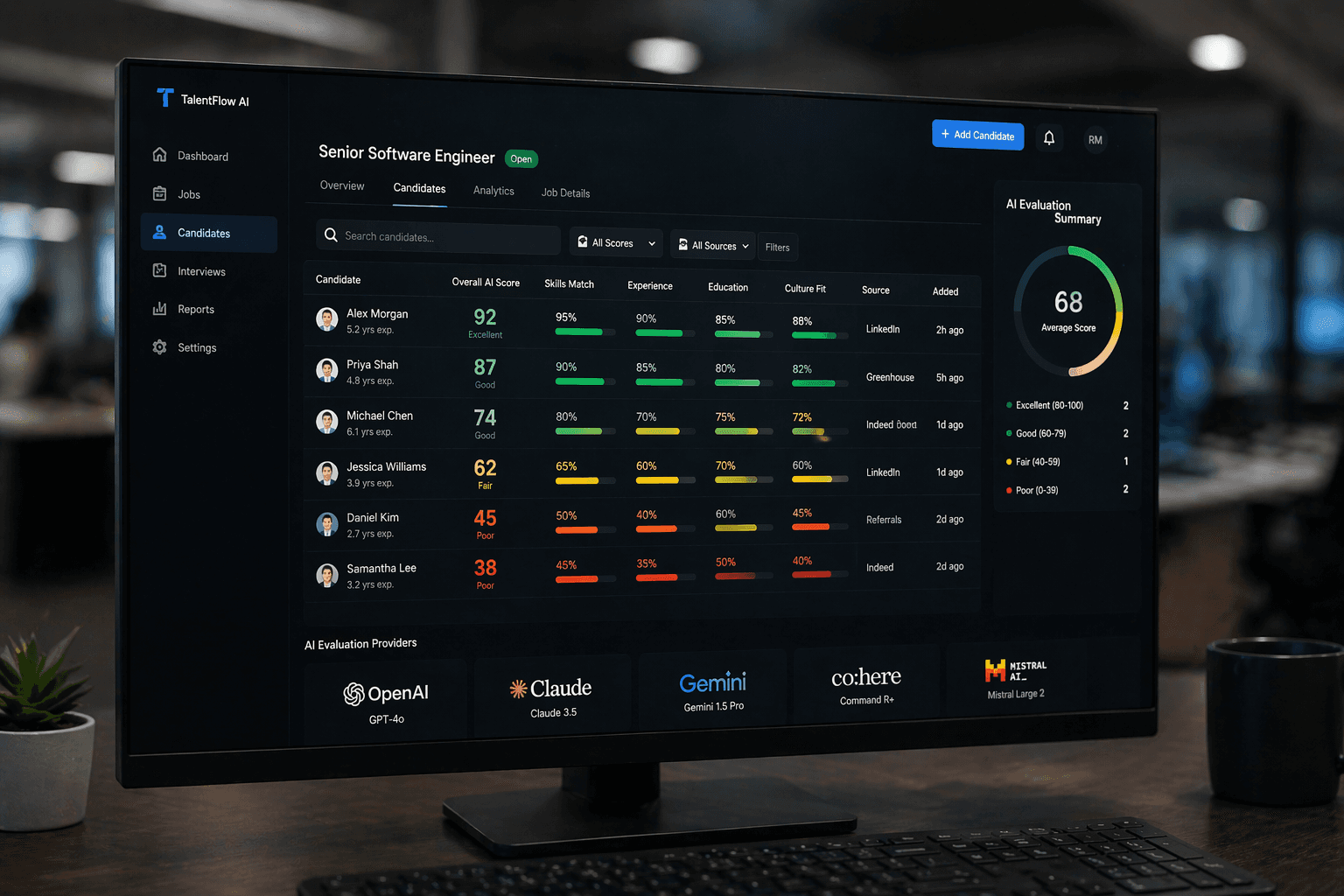
Here's what resume screening looks like in most organizations:
A job posting goes live. 150 applications arrive in 48 hours. An HR coordinator opens the first PDF, reads it for 90 seconds, and makes a call based on a gut feeling and whether the formatting is clean.
By application 40, they're skimming. By application 80, they're fatigued. By application 120, they're copying scores from the person before and hoping for the best.
That's not a hiring process. That's a coin flip with extra steps.
I built the AI Resume Reviewer to fix this — a multi-LLM screening platform that has now processed over 2,000 resumes across 3 HR departments, with structured verdicts, evidence-based scoring, and the ability to swap AI providers without touching a line of code.
The Problem with Every Other AI Resume Tool
Most AI hiring tools have the same fatal flaw: they're built on one provider's API. OpenAI today, price hike tomorrow, scramble to re-architect next quarter.
Beyond vendor lock-in, they give you a score. Not a verdict. Not a rubric. Not an evidence trail you can defend to a hiring manager or a candidate.
A number isn't a hiring decision. A structured, evidence-anchored scorecard is.
How It Works
The system is a Streamlit web application with a multi-provider LLM dispatch layer. Here's the full pipeline:
→ Input: Job description (optional) + resume files. Supported formats: PDF, DOCX, DOC, PNG, JPG, TIFF, BMP, WebP, or a ZIP archive of hundreds of files at once.
→ Text Extraction: Selectable text PDFs via PyPDF2. Scanned PDFs and images via Chandra OCR API. Word documents via python-docx. The system handles resumes that most tools reject outright — scanned documents, photographed pages, image-only PDFs.
→ LLM Dispatch: Select your provider from the sidebar. The same evaluation runs on Claude (Anthropic), Gemini (Google), GPT-4 (OpenAI), Llama/Mixtral (Groq), or Ollama — any local model with zero data leaving the building.
→ Structured Scorecard Output: The LLM returns a strict JSON scorecard — not free text, not a paragraph, not a hallucinated recommendation. Every field validated before display.
Three Scorecards. Nine Dimensions. One Verdict.
The system ships with three domain-specific evaluation templates:
AI Advisor — for AI specialist roles in international development organizations (UN, World Bank, USAID): 9 scored dimensions including AI Knowledge, Donor Experience, Technical Expertise, AI Capacity Building, and Strategic Skills.
General — universal professional screening for any role: 8 dimensions covering Education, Experience Depth, Technical Skills, Leadership, Sector Fit, Analytical Thinking, Communication, and Completeness.
STL Consultant — short-term local consultant screening for NGO/INGO roles: 7 dimensions including NGO Experience, Thematic Relevance, and Stakeholder Engagement.
Every dimension scored 1-5. Every score requires evidence from the resume text — no inflation, no uniform 3s, no hallucinated endorsements. The final output: "Strongly Recommend" / "Recommend" / "Consider" / "Do Not Recommend" — with deterministic decision logic, not vibes.
The Excel Export: Built for Decision-Making
Every batch produces a color-coded Excel file built for the hiring manager who wasn't in the room:
→ Red scores (1-2) surface critical gaps immediately
→ Green scores (4-5) highlight standout candidates
→ Overall % column sorts by suitability in one click
→ Verdict column color-coded by recommendation tier
→ Auto-filter on every column for slicing by facility, dimension, or score range
Three HR departments have used this export as the primary input to their shortlisting process.
The Results
→ 2,000+ resumes evaluated across production deployments
→ 3 HR departments using the system for active hiring cycles
→ 5 AI providers supported — switch in the sidebar, no code change required
→ Batch processing via ZIP upload — screen 100+ candidates in a single session
→ Local inference option via Ollama — for organizations that can't send data to public APIs
The GitHub repository (shikaasor/ai_resume_review) is public and MIT-licensed.
The Takeaway for Founders and HR Leaders
If your hiring process depends on a person reading 150 PDFs and trusting their instincts — you're not screening candidates. You're introducing randomness into the most consequential decisions your organization makes.
AI doesn't remove judgment from hiring. It removes exhaustion. The right tool gives your team a structured starting point, an evidence trail, and the time to spend their expertise where it actually matters.