Most companies deploy a chatbot and declare the problem solved.
They look at the dashboard. Conversations handled: ✓. Human escalations reduced: ✓. Support tickets deflected: ✓.
What they're not looking at is the conversation that ended with: "I don't have specific information about that. Please contact us at support@company.com."
That sentence — or some variation of it — is the most expensive line in your chatbot's vocabulary. It tells a customer you built a system that can't answer their actual question. Then it asks them to go find a human to do what the chatbot was supposed to do.
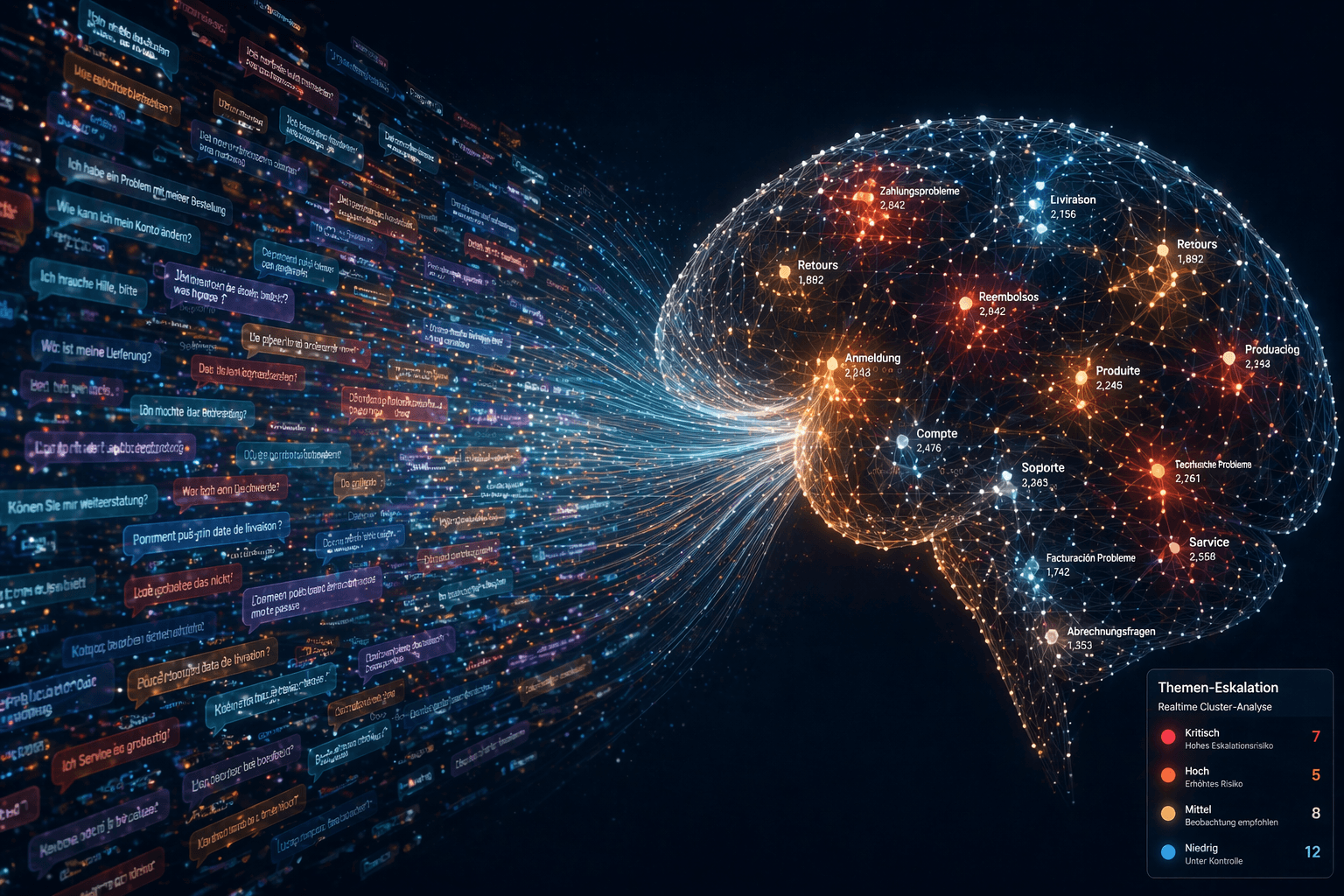
I built an NLP analytics pipeline to find every instance of that failure — and everything it cost.
The Client and the Problem
A Swiss pet insurance company had deployed an AI chatbot to handle customer service 24/7. The bot was multilingual — German, French, Spanish — and covered a broad set of FAQs around policies, claims, coverage, and account management.
The product team had a nagging problem they couldn't quantify: customers were escalating to human agents at a higher rate than expected. They didn't know why. They didn't know which topics were failing. They didn't know if the knowledge base was the issue or the model or both.
They had the data — 16,454 conversation log entries. They didn't have the analysis.
The Pipeline
→ Data Ingestion and Cleaning: Raw CSV logs with session IDs, roles (user/assistant/system/contact_form), messages, and timestamps. Signal extraction — stripping system noise, normalizing encoding across three languages, and grouping messages into user-assistant conversation pairs by session.
→ LLM-Based Multi-Dimensional Classification: Each conversation pair was classified across four dimensions simultaneously using GPT-4 and Gemini with an abstracted dispatch layer:
→ Topic Category — 15 predefined categories (Policy Details, Claims & Reimbursement, Account Management, Technical Support, Billing, and more) with confidence scoring per classification.
→ Knowledge Gap Detection — Binary flag (DATA_GAP / OK) identifying conversations where the chatbot signaled it couldn't answer. Not keyword matching — semantic understanding of partial answers, redirects, and deflections.
→ Human Escalation Detection — Binary flag (ESCALATION / OK) capturing both explicit requests and implied frustration, with confidence scores of 0.85-0.95 on high-signal conversations.
→ Engagement Pattern Analysis — Time-series analysis of conversation volume by day and hour, surfacing peak load periods and anomalous spikes.
→ Structured Reporting: Output — a color-coded, multi-sheet Excel report with categorized conversations, summary statistics, topic distribution, and escalation analysis — plus three standalone insight documents.
What the Data Revealed
The findings fell into three categories, and none of them were what the client expected.
Finding 1: The knowledge base covered FAQs. Not operational reality. The chatbot could explain what the policy covered in general terms. It could not answer whether a specific treatment was covered for a specific breed at a specific age, why a claim was partially paid, how long the current claims queue actually was (answer: 16-30 days), or whether a policy could be modified after activation. These aren't edge cases. They're the questions customers actually have.
Finding 2: Escalations were almost never random. When we mapped escalation conversations against topic categories, a pattern emerged immediately. The highest escalation rates were in Claims & Reimbursement and Specific Coverage Details — the same topics driving the knowledge gaps. Customers weren't escalating because they preferred humans. They were escalating because the chatbot had already told them it couldn't help.
Finding 3: Peak load correlated with policy lifecycle events, not time of day. The most significant engagement spike — 53 conversations in a single day — didn't follow a predictable daily pattern. It correlated with a specific external event that drove a batch of customers to the same set of questions simultaneously.
The Fix Isn't More AI. It's Better Intelligence.
The temptation after an analysis like this is to upgrade the model. Bigger model, better answers. That's the wrong instinct.
The problem wasn't model capability. The problem was that nobody had systematically mapped what questions customers were actually asking against what the knowledge base actually contained.
The gap between those two things is operational blindness. And it compounds silently until someone measures it.
The right fix:
→ Expand the knowledge base with operational-level policy detail — not just FAQ summaries
→ Build direct integrations with claims systems so the bot can surface real status, real timelines, real answers
→ Add a smooth human handoff with conversation history so the agent isn't starting from scratch
→ Run this analysis quarterly — the gaps change as the product evolves
A chatbot that knows what it doesn't know is infinitely more valuable than one that deflects confidently.
What This Looks Like for Your Organization
If you have a deployed chatbot and you're not regularly analyzing where it's failing — you're flying blind. Your customers know exactly where the gaps are. The conversation logs know too. You just haven't looked.
I build NLP analytics pipelines that turn conversation data into actionable intelligence: knowledge gap maps, escalation drivers, engagement patterns, and structured recommendations your product team can act on immediately.
No generic dashboards. No vanity metrics. The intelligence your system needs to stop bleeding customers in silence.